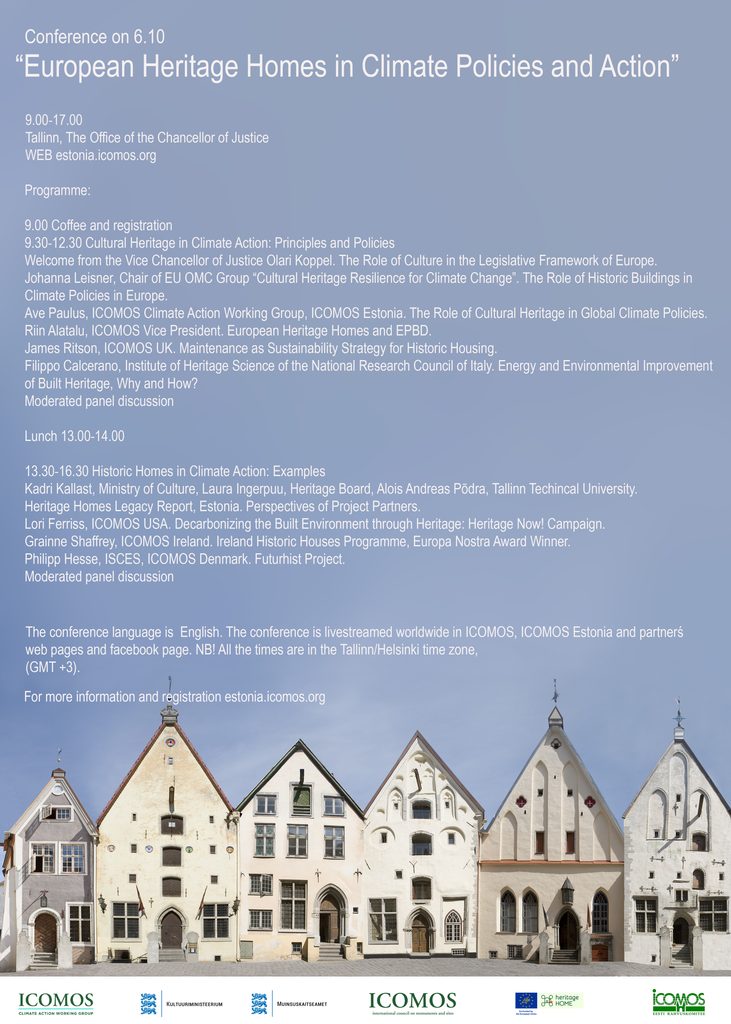
Conference “European Heritage Homes in Climate Policies and Action”, 6 October, Tallinn and Livestream
Zoom link with translation
https://us06web.zoom.us/j/89375891285?pwd=XzbqtqfmAEbiMlzBmGlfiTw2069pbS.1
Conference Venue: The Office of the Chancellor of Justice History of the building | Õiguskantsler
Organisers: ICOMOS Estonia in cooperation ICOMOS Climate Action Working Group, ICOMOS ISCES and ICOMOS Europe group, Ministry of Culture of Estonia, Ministry of Climate of Estonia, National Heritage Board, Tallinn University of Technology, Estonian Academy of Arts, Chancellor of Justice
Europe’s green transition must build upon its cultural foundations. Europe’s path toward climate neutrality must be one that values its past as much as its future. Historic buildings are living witnesses of our shared heritage, identity, and craftsmanship – yet they are too often overlooked or treated as obstacles in the race towards energy efficiency. Historic buildings are living assets – repositories of craft, identity, and embodied energy. Their continued use and adaptation are critical for achieving climate neutrality.
Aims of the conference: 1) to highlight current trends and strategies for cultural heritage and historic buildings in climate policies in the world and in Europe; 2) to exchange experiences from ongoing research and development programmes on the role of historic buildings in climate action and energy renovation; 3) to discuss challenges and ways forward on the climate action for historic buildings from policies to practice
Programme:
8.45-9.30 Coffee and registration
9.30-13.00 Cultural Heritage in Climate Action: Principles and Policies
Moderators: Elina Liiva and Helena Männa
Welcome from the Vice Chancellor of Justice Olari Koppel. The Role of Culture in the Estonian Constitution and the Legislative Framework of Europe.
Johanna Leisner, Chair of EU OMC Group “Cultural Heritage Resilience for Climate Change”. The Role of Historic Buildings in Climate Policies in Europe.
Ave Paulus, ICOMOS Climate Action Working Group, ICOMOS Estonia. The Role of Cultural Heritage in Global Climate Policies.
Riin Alatalu, ICOMOS Vice President. European Heritage Homes and EPBD.
11.00-11.20 Coffe break
James Ritson, ICOMOS UK. Maintenance as Sustainability Strategy for Historic Housing.
Filippo Calcerano, Institute of Heritage Science of the National Research Council of Italy. Energy and Environmental Improvement of Built Heritage, Why and How?
Moderated panel discussion
13.00-14.00 Lunch buffet
14.00-16.30 Historic Homes in Climate Action: Examples
Kadri Kallast, Ministry of Culture, Laura Ingerpuu, Heritage Board, Alois Andreas Põdra, Tallinn Techincal University. Heritage Homes Legacy Report, Estonia. Perspectives of Project Partners.
Lori Ferriss, ICOMOS USA. Decarbonizing the Built Environment through Heritage: Heritage Now!
Grainne Shaffrey, ICOMOS Ireland. Ireland Historic Houses Programme, Europa Nostra Award Winner.
Philipp Hesse, ISCES, ICOMOS Denmark, Futurhist Project.
Moderated panel discussion
16.30 Coffee
Optional, for the conference participants. Walk through Old Town Tallinn to the Centre of Sustainable Renovation and afterparty supported by ICOMOS Estonia
The conference is supported by the LIFE heritageHOME programme, led by the Estonian Ministry of Culture and co-funded by the European Union, launched to promote energy retrofitting of historical buildings while preserving their culturally valuable qualities. The Legacy Report of the three year project, coming to end in October 2026, will be presented at the conference, including a demo of the newly piloted online renovation services to assist homeowners. Find out more about the programme: https://www.kul.ee/en/heritagehome.
The conference is targeted to European policy makers, heritage experts, architects and engineers, state and local administrations, heritage communities and scientific networks.
The conference language is English, with a simultaneous Zoom translation option. The conference is livestreamed worldwide in ICOMOS, ICOMOS Estonia and partnerś web pages and facebook page. NB! All the times are in the Tallinn/Helsinki time zone, (GMT +3).
Registration link https://forms.gle/p9MEwjrRcGfnGtTw9
Zoom registration give spossibility for Zoom translation to several langauges, including Estonian and French
Contact: estonia@icomos.org
Presenters:
OLARI KOPPEL
Vice Chancellor of Justice
Welcome: The Historic Building of the Chancellor of Justice’s Office
Olari Koppel graduated from the Faculty of Social Sciences at the University of Tartu in 1995. He has worked in public service since 2000. From 2006 to 2012, he served as an adviser to the President of the Republic of Estonia. Since 2015, he has been the Director of the Office of the Chancellor of Justice.
The building housing the Office of the Chancellor of Justice is a good example of how a historically and architecturally significant heritage building can serve the public interest while remaining accessible to all (employees with special needs, people seeking the assistance of the Chancellor of Justice, art enthusiasts, seminar participants and others). The public sector does not necessarily have to operate out of modern zero-energy buildings. Instead, under the leadership of the Office, the building has been gradually renovated over the past 10–15 years, as resources have allowed.
The building reflects Estonia’s history: once the urban residence of Baltic German manor owners, it has served the public since 1919, when government institutions first began operating here.
JOHANNA LEISNER
Chair of EU OMC Group “Cultural Heritage Resilience for Climate Change”
The Role of Historic Buildings in Climate Policies in Europe
Johanna Leissner studied chemistry and has been working in cultural heritage research for over 30 years. She has chaired the OMC Expert Group of European Member States and is currently commissioned to prepare a report for the STOA Panel of the European Parliament on technologies for the preservation of cultural heritage in times of climate change.
The presentation will be about the role of the EU`s policies in responding to the different threats of climate change and how they affect cultural heritage, what kind of technologies are available to tackle the challenges highlighted by examples from Europe which illustrate how different technologies are already being applied, tested or combined in diverse cultural heritage and climate-risk contexts.
AVE PAULUS
ICOMOS Climate Action Working Group Focal Point
ICOMOS Estonia, President
The Role of Cultural Heritage in Global Climate Policies
Ave Paulus is a heritage expert and researcher focused on the cultural continuity of heritage ecosystems and the rights of heritage communities, with a specific focus on climate and heritage policies. With over 20 years of experience in Estonia’s Ministry of Climate, Environmental Board of Estonia as a cultural heritage expert, she now focuses on international cooperation and policy. MSc, Estonian Academy of Arts, PhD, Tartu University.
The presentation highlights current trends and strategies for cultural heritage and historic buildings in climate policies within UNFCCC and UNESCO processes from the perspective of ICOMOS contributions. The author argues for the importance of implementation pathways and mechanisms that move from science to policy to practice, the importance of including heritage voices advocating for historic buildings and related knowledge, and the progress made in the international arena in recent years in this respect.
RIIN ALATALU
ICOMOS Vice President
European Heritage Homes and EPBD
Riin Alatalu is the Vice-President of ICOMOS and associate professor at the Estonian Academy of Arts cultural heritage and conservation department. Her work focuses on administration and legislation of heritage, as well the vernacular, 20th century and dissonant heritage.
Energy Performance of Buildings Directive is one of the key legislative documents that influences the built heritage. To foster the inclusion of the heritage sector and heritage aspects in the implemantation of the directive, the ICOMOS Europe group created an Expert Group to monitor the implementation of the Directive in European countries. The presentation highlights the conclusions of a report by the working group.
JAMES RITSON
Associate Professor, University of the Built Environment, ICOMOS UK
Maintenance as Sustainability Strategy for Historic Housing. Building Maintenance and benign changes – the foundation for a sustainable future for our historic housing stock [KM1]
Dr James Ritson is an Associate Professor at the University of the Built Environment, specialising in the sustainability of the existing built Environment. He is an expert member of ICOMOS and former Vice President of the ICOMOS Scientific Committee of Energy and Sustainability.
Building maintenance has long been an established part of building conservation work, but through maintenance and small, benign changes, significant improvements to a building’s energy performance and carbon emissions can be achieved while preserving the building’s cultural value in a cost-effective way.
FILIPPO CALCERANO
Senior Researcher at the Institute of Heritage Science, National Research Council of Italy
Energy and Environmental Improvement of Built Heritage, Why and How?
Filippo Calcerano is an expert in climate mitigation and energy and environmental improvement of built heritage, focusing on diagnostics, building and urban microclimate performance simulations, and Heritage Building Information Modelling. As a member of the Climate Heritage Network, Dr. Calcerano is also engaged in outreach and advocacy activities to address the “culture gap” in climate policy and support culture-based climate action, capacity building and technological transfer activities.
The integration of environmental design and conservation theory provides a valuable framework for guiding climate mitigation interventions on built heritage and preventing maladaptation. After outlining the theoretical foundations of this approach, the presentation showcases case studies from research projects that illustrate a workflow combining diagnostics, information management, and dynamic simulations to support evidence-based interventions.
KADRI KALLAST
LIFE heritageHOME project manager at the Estonian Ministry of Culture
Historic Homes in Climate Action: Examples (co-presented with L. Ingerpuu and A. A. Põdra)
Kadri Kallast is Project Manager of the LIFE heritageHOME project at the Ministry of Culture of Estonia and a doctoral researcher at the Estonian Academy of Arts. Her work focuses on the intersection of heritage conservation, climate adaptation and homeowner support, with a particular interest in making heritage preservation more accessible and people-centred.
Renovating a heritage home is often a complex journey shaped by technical, regulatory and financial challenges. This presentation explores how the LIFE heritageHOME project responded to these challenges by creating practical tools, expert support services and policy recommendations that make heritage-sensitive renovation easier and more accessible for homeowners.
LAURA INGERPUU
Estonian National Heritage Board
Historic Homes in Climate Action: Examples (co-presented with K. Kallast and A. A. Põdra)
Laura Ingerpuu works as a built heritage adviser at the Estonian National Heritage Board and has been responsible for coordinating the LIFE heritageHOME project for the past three years. She is a PhD candidate and lecturer at the Estonian Academy of Arts, where her research focuses on 20th-century architecture, particularly socialist heritage. Laura is also a member of ICOMOS Estonia and the ICOMOS International Scientific Committee on Twentieth Century Heritage (ISC20C).
ALOIS ANDREAS PÕDRA
Early-stage researcher at Taltech and researcher at Estonian Open Air Museum
Historic Homes in Climate Action: Examples (co-presented with L. Ingerpuu and K. Kallast)
Alois Andreas Põdra is a researcher of building renovation, primarily focusing on measures and technical solutions for raising the energy performance of single-family houses and historic buildings in Estonia.
LORI FERRISS
Executive Director, Built Buildings Lab
Decarbonizing the Built Environment through Heritage Now!
Lori Ferriss (AIA, PE, LEED AP BD+C), is Co-Founder and Executive Director of Built Buildings Lab and an internationally recognized architect and engineer focused on leveraging existing and historic buildings for equitable climate change mitigation and adaptation. She sits on the board of the ICOMOS International Scientific Committee on Energy and Sustainability, is a past Chair of the American Institute of Architects Committee on the Environment (COTE), and serves on the Climate Heritage Network Steering Committee.
Built heritage around the world demonstrates a range of proven, measurable, and largely underrecognized decarbonization solutions. This presentation will share principles, case studies, and key policy levers from the Decarbonizing the Built Environment through Heritage initiative and present how built heritage is being integrated into the UNFCCC Global Climate Action Agenda.
GRÁINNE SHAFFREY
Director Shaffrey Architects, Grade 1 Conservation Architect, ICOMOS Ireland
Ireland Historic Houses Programme, Europa Nostra Award Winner. Improving energy performance of heritage buildings in Ireland: from 2010 to 2026+[KM2]
Gráinne Shaffrey is a Conservation Architect and Urban Designer and Director at Shaffrey Architects. Along with her colleagues, she has been involved in a range of architecture and urban project focused on sustainable solutions which aim to enhance cultural and social aspects with low environmental impact. Research is an important element of her practice.
Gráinne led the consultant design team for the OPW Improving Energy Efficiency in Historic Properties in State Care Initiative, which won a 2026 Europa Nostra Grand Prix.
Gráinne is a member of ICOMOS Ireland and actively involved in ICOMOS at national and international level.
Gráinne will present an early historic house upgrade from 2010, which has provided an informal learning laboratory, alongside the recent Europa Nostra Grand Prix winning ‘OPW Improving the Energy Performance of Heritage Properties in State Care Initiative’. Both show the positive contribution historic buildings can make in the climate crisis and the importance of a collaborative, well planned process.
PHILIPP HESSE
General Secretary ISCES (The International Scientific Committee on Energy, Sustainability and Climate Change)
FuturHist – tailored intervention solutions for replicable retrofits for historic buildings
Philipp Hesse is a German architect based in Denmark, founder of HEJ arkitekter, whose transnational work combines contemporary architectural practice, heritage conservation, and research into historic building fabric. He serves on the board of ICOMOS Denmark and as General Secretary of ISCES, and contributes to the European ICOMOS research project FuturHist.
FuturHist develops typology-based, replicable approaches to improve the energy performance, comfort and resilience of historic buildings while respecting their cultural values. This presentation introduces the project’s technical and knowledge-exchange work, including the ICOMOS Knowledge HUB and invites to share transferable practices for heritage retrofit across Europe.